



transformation
 Ollersdorf, Austria
Ollersdorf showcases local energy resilience through Renewable Energy Communities
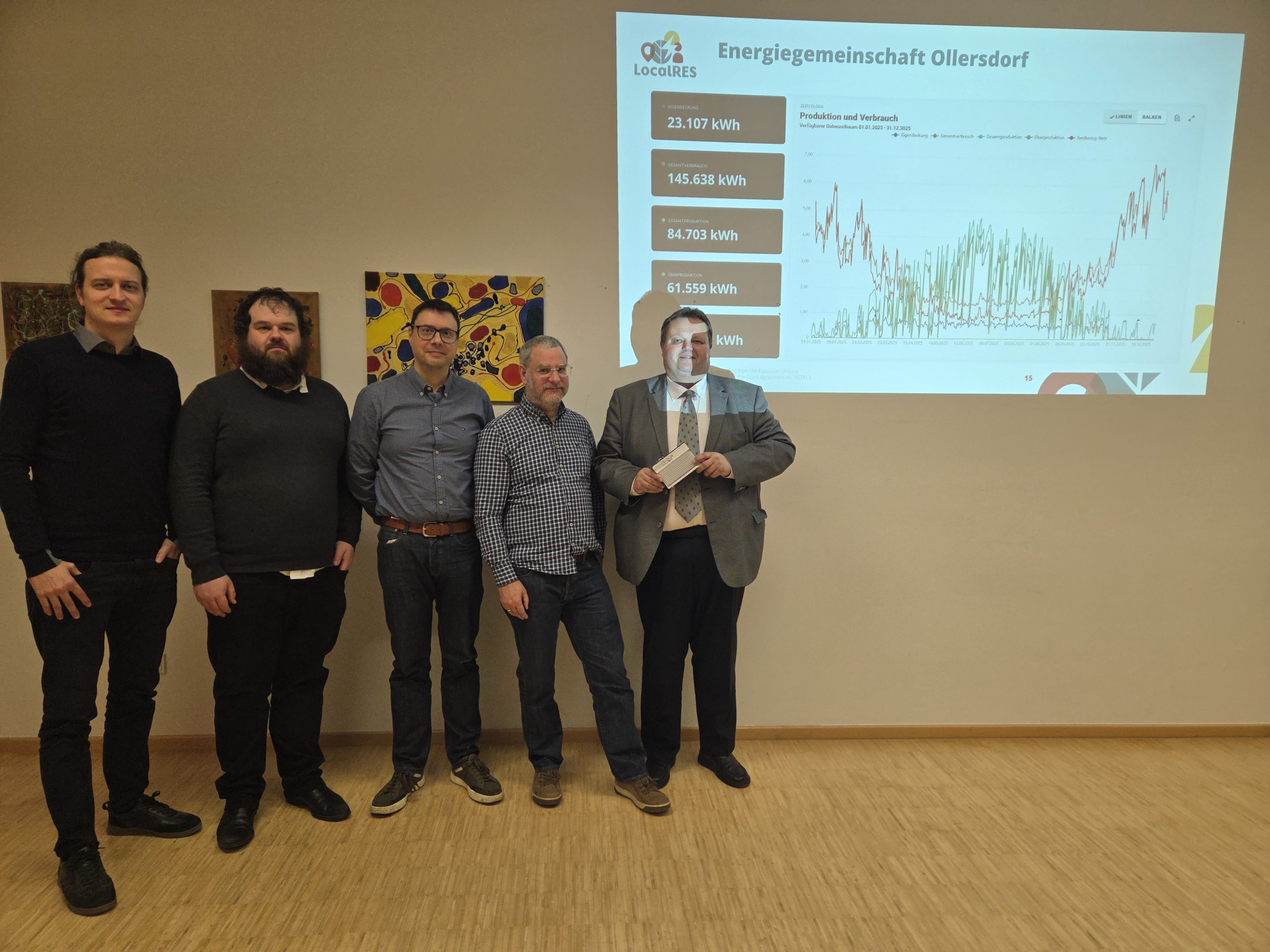
On 30 March 2026, the municipality of Ollersdorf in Burgenland, Austria, hosted the final LocalRES event linked to the project’s stakeholder engagement activities. Organised at the Ollersdorf municipal office, the workshop brought together local authorities, technical experts, research partners, Renewable Energy Community representatives and citizens to share the main results of five years of European research and practical implementation.
The event opened with welcome remarks from Mayor Bernd Strobl, followed by a presentation of the LocalRES project, its objectives and Ollersdorf’s role as a demonstration site. Within the project, Ollersdorf served as a real-life testing environment for technical, organisational and governance solutions supporting local renewable energy systems, energy autonomy and resilience.
A central part of the workshop focused on future energy scenarios developed for Ollersdorf. These explored different decarbonisation pathways, including increased photovoltaic deployment, flexibility measures, blackout resilience solutions, heat pumps, electric vehicles, storage systems and even a hydrogen transport scenario involving hydrogen-powered school buses. The results showed that reaching a high level of electrical self-sufficiency would require a major expansion of local renewable energy infrastructure.
The workshop also addressed the practical challenges of integrating high shares of renewable energy into local electricity grids. AIT presented the Grid Capacity Manager, a software solution developed within LocalRES to monitor local energy flows and coordinate distributed energy assets such as batteries, electric vehicles and photovoltaic systems. This coordination can help prevent grid congestion, improve voltage stability, support flexibility services and optimise local self-consumption.
Participants also learned about the digital and physical infrastructure implemented in Ollersdorf, including one of Austria’s early Renewable Energy Communities, real-time monitoring across around 15 buildings, battery storage systems, and software platforms for monitoring, device management and automated coordination of distributed energy resources.
Energy resilience was another key theme of the event. Researchers from the University of Passau presented scenarios showing how local renewable energy assets and storage systems could help maintain energy supply during major disruptions or blackout events. Discussions covered island operation, black-start strategies, flexibility management and the technical and regulatory conditions needed for local energy systems to operate autonomously in emergencies.
A strong message from the workshop was that renewable energy systems do not necessarily create instability in local grids when they are properly coordinated. On the contrary, LocalRES results showed that intelligent management of flexibility, storage and distributed generation can improve grid stability, increase energy autonomy and strengthen resilience.
The event concluded with a broader presentation of the LocalRES demonstration sites across Europe, including Berchidda, Ispaster and Osimo, underlining the transferability of the solutions tested in Ollersdorf.
Overall, the workshop showed how small municipalities can play a leading role in the energy transition. Ollersdorf demonstrated that renewable energy deployment, citizen participation, digital tools, flexibility management and resilience planning can work together to build more secure, decentralised and sustainable local energy systems.
